
Getting Schooled on a Keke
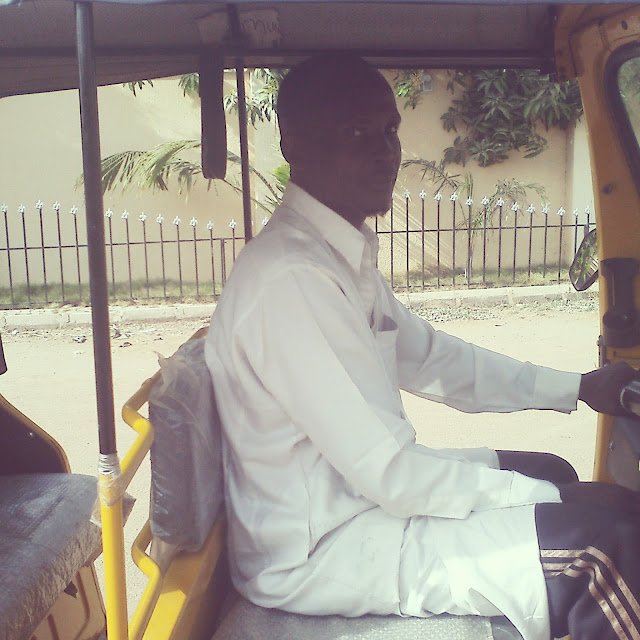
Muhammad Bala, a keke rider in Yola, Adamawa State.Image: Ramatu Ada Ochekliye I had just come out of the Jimeta Modern Market in Yols, Adamawa State, when this Keke (tricycle) rider asked where I was going. I didn’t answer. As I crossed the road, he also took a U-turn and parked just in front of me. He asked again where I was going. I told him my house address and he told me ₦100, which was ₦30 more than I normally pay. My arms were hurting from lugging my purchases so I sighed and got into the Keke. As we were about to move, a woman flagged him down and mentioned a location en route my house. The rider told her to come in. She had lots of things and took some time stuffing them in the space behind. When she was settled in, we set off. No one spoke until we got to the woman’s destination. She dropped in front of a Buka (local restaurant) and her kids came running. As they teased her about coming home early from the market, they offloaded her stuff from the Keke. One of her daughters said in Hausa, ‘Thank GOD you are back because all the food is finished and you need to start cooking.’ The Keke rider and I looked on at the drama until they were done getting her things off the vehicle. I really can’t remember what one of her sons said but it got all of us laughing; well, I was tired, so I just smiled. When we set off, he started a conversation. Now, this happened in Hausa and though my spoken Hausa is stilted, I think this is an almost perfect replica of the conversation we had. He started with, ‘See how her children are helping her? That is how it is supposed to be.’ I responded with a ‘Mhmmm.’ and he continued. ‘You know that food business never goes out of style. You can always make money with a food business.’ I nodded and knowing he wouldn’t see my response, added ‘That is true. No matter what type of restaurant you run, people will always come to you. But the amount of money you make is dependent on the location of your restaurant.’ ‘And the fact that her children are helping her means that she will not have to spend so much money on help and food. The children can eat from what she cooks for her customers and that way, she is able to save a lot’, he finished. I don’t know why but I decided to have a full conversation with him. I even went personal! ‘You are right. My mother owns her own restaurant and when we are around, we help her out. And just like you said, we eat from what she cooks so that sometimes, we don’t need to have food at home’, I said with excitement. ‘Is your mother’s restaurant in this town?’ he asked and I told him no, it is in Abuja. He went further to say that because of the state of the economy, it was important for people to have some of these businesses so they can make money. He then went on to say that many people were waiting for jobs that may or may not come instead of looking for how to earn something based on the basic needs of people. By this time, we were passing in front of Adamawa State Polytechnic, Yola, or SPY as it is popularly called. There was this lady in front who flagged him down. He stopped in front of her but it turned out that she was not going our way. I didn’t notice the bound project she was holding, but he did. As we set off again, he asked if that was her final year project or something. I looked out of the Keke and tried to get a glimpse at what she holding but as he pulled away, I knew I wouldn’t see anything. I pulled my head back in and said it could probably be her project. That was when the discussion got really interesting. ‘You know that graduates are the problems in this country. They are very lazy and always want that ₦150,000 job. Instead of doing the businesses they consider petty, they will rather waste away at home doing nothing. That is why graduates are not the richest in this country.’ My antenna went up pretty fast! Did this man just diss me and all graduates in Nigeria? I felt like I had to say or DO something to redeem our collective image. ‘It is graduates that have no sense that waste away. Many sensible graduates even work two jobs and manage their own businesses but….’ And he interrupted me. ‘They are very few and in between! Most graduates are waiting for government jobs that will pay them ₦30,000. What is ₦30, 000?! They have to feed, clothe, pay rent and still send money to their family with that money. How can they save with that? How much will they even save?!’ I knew he was right but before I could formulate an appropriate response, he continued. ‘Let me tell you a story. I graduated from that SPY that we passed. I waited for two years trying to get a job. The job was not coming. People would promise you all kinds of things but they would fail. One day, a friend came to me and said we should go to Calabar to find work. I had nothing in Yola so it was not hard to agree. I packed my stuff and we went to Calabar. ‘For two whole months, I didn’t make up to ₦5000. In fact, we both didn’t make up to ₦5000; collectively! My friend was tired and said he would return to Yola. Somehow, I convinced him and we stayed a couple more months. When he couldn’t stand it anymore, he returned to Yola. I couldn’t do that. I couldn’t return to Yola a failure. So I stayed back, got a

