
The Agony of Water Scarcity
Photo by Tucker Tangeman on Unsplash THROUGH THE EYES OF OJONUGWA YAHAYA INTRODUCTION Located in an atmosphere of serenity and decorated with the rich savannah vegetation, the communal life and practice of trade by barter is still held with great prestige in the community of Ojokpachi-Odo. Ojokpachi is one of the villages in Omala Local Government Area (LGA) of Kogi State. The years I spent growing up with my grandmother in Ojokpachi would have been nothing short of amazing and enjoyable if we had access to clean and accessible water. The major source of water in the community is the stream (Oche and Oshumamanyi), while those that can afford hand-dug wells have it close to their compounds. The quality of the well water is determined by the nature of the soil where the well is situated, and it is not all the available wells that produce good, safe water. The well in my family compound produces hard water (highly concentrated in calcium and magnesium carbonates, bicarbonates and sulphates). The water is not good for drinking. We usually manage it for other domestic use such as cooking, bathing and washing, though the water does not lather well with soap, so it does not really wash cloths clean and ends up leaving the skin looking white and dry after every bath. During the raining season, we practice rainwater harvesting; a practice where my grandmother usually collects drinking water into special clay pots. The journey of water collection to the nearby stream during raining season is usually much easier, even with the distance of about 6 kilometres. Because the stream is full, and water flows freely during this time, we can make up to five (5) trips at a stretch. It is important to note that water collection in most households in the community is predominantly done by women and girls, making life difficult for women and girls. When school is in session, children of school age like me normally go for water collection first thing in the morning before setting off to school. When we get to school, some of us are assigned to fetch water to teachers houses as part of our labour duties. On getting home and having a rushed lunch, we set off for another round of water collection for the household until the available large water containers are filled up. It is an everyday routine. When school is not in session, we usually fetch water before going to farm. During the dry season when water scarcity reaches its peak, when the stream dries up and wells do not get to produce enough water, life in the village become as hard as you can imagine. We have to walk several miles – beyond 6 kilometres – in search of water. Women and girls set out as early as 3:00am or as soon as the cock crows to go in search of water, carrying touch lights in their hands. Women use cutlass to dig shallow ponds in the moist part of the stream, which is now dried, then wait patiently for the water to gather before scooping it with a little bowl into to a larger round container/basin which is equivalent to 25 litres keg. The queue usually become very long as the day breaks, sometimes water collection may take the whole day. The best time to get water from the shallow pond is very early in the morning or at midday when most people have gone to the farm, because the moment most of the people get back from farm the queue become unbearable. Sometimes, after waiting for hours, and getting to evening when the sun finally disappears, one may return home with an empty container. When the water situation becomes tougher, women and their children (girls) take time off farming activities completely to dedicate more days to fetching water. In this case the mother will be at the water source, scooping water from the hand-dug pond… scooping and waiting for it to gather again as if she is counting every drop, while the children will concentrate on carrying the water home. The journey home is never easy at this point, as our neck aches, with the centre of the head pleading for freedom from the water load, and shaky legs climbing the stony hill and walking the sloppy paths. The feet feels the hardness of the stones under the flip-flop slippers and bodies soaked with the constant droplets from the edge of the large basin, balanced on the head and held with both hands. One trip can take one and half hours. In some cases men who have bicycles go farther along the farm road with their kegs tied to the back of their bicycles in search of where the stream had formed a pond and is yet to dry up. Though the water gotten from there is usually dirty, brownish in colour and has odour due to dry leaves falling into the pond or as a result of cattle coming to drink from it. Usually when men fetch water, it is for their own personal use: for laundry and bathing and not for the entire household use as they believe that fetching water for the household is the duty of women and girls. My grandmother use to join us to fetch water but at a point due to old age, she did not have the strength to carry water, or wait on the queue to scoop water from the shallow hand-dug pond. But whenever me and my little sister go for water collection, she appreciates us a lot, calling us sweet names or our clan’s greeting name (Oyowo-gida), and adding larger portions of dry fish to our dinner. My grandmother feels our pains and wishes she could help. On several accessions, either me or my sister will return from the stream with swollen face from bee stings and my grandmother will cry and say we should not go to collect water again, but if we do
Open Defecation: A Known Enemy Affecting the Everyday Nigerian Life
Old woman showing her makeshift toilet.Credit: UN NewsBy Ojonugwa Yahaya from HipCity Innovation Centre Among human communities, there are some behaviours which have negative impact the people and endangers the health of the entire population. Most times, the people ignore the consequences because they believe it is an age-old practice and their forebears were not affected by it, or because of a fear of change. Also, when these people weigh their options and feel the cost of behavioural change outweighs their usual behaviour, they are usually unwilling to change. On the list of such unhealthy behaviour is the monster called open defecation (OD). Open defecation is the emptying of bowels in the open without the use of properly designed structures built for the handling of human waste such as toilet. People may choose to defecate in the fields, bushes, forest, canal, ditches, street or other open space. According to World Health Organisation open defecation pollutes the environment and causes health problems. Open defecation is linked to the high prevalence of water-borne infectious disease such as Diarrhoea, Cholera and Hepatitis A, among others. It is also linked to high child mortality, poor nutrition and poverty in Nigeria. The reasons that have been given by people who practice the habit of open defecation have either been poverty that makes it a challenge to build latrines or lack of government support in providing toilet facilities. In cases where the toilets are available, but people still end up preferring to defecate in the open, the reason can extend to cultural beliefs related to sharing toilets among family or non-family members. An example is can be found in communities where it is forbidden for a man to share the same toilet with a woman who is menstruating or a woman who newly gives birth to a child. In some other cases, people prefer open-air defecation due to the freedom it gives them as opposed to using a small dark structure or the inconvenience of using toilets that are dirty due to poor maintenance culture. Open defecation in Nigeria has a negative impact that cannot be overemphasised. It is not limited to local communities: even in the bustling city centres, open defecation is practiced predominantly by the people in these communities. Take the Federal Capital Territory (FCT) Abuja for example. In communities such as Shere (Bwari), Rije (Kuje), Leleyi Gwari (Kwali), Kaida (Gwagwalada), and even in the city centre like Jabi (Jabi Motor Park) and Utako Market etc, open defecation is very obvious. Following the declaration of a state of emergency on Nigeria’s Water supply, Sanitation and Hygiene (WASH), the inauguration of the National Action Plan for the Revitalization of Water supply, Sanitation and Hygiene (WASH) by the Nigerian government at the State House Conference Centre on 8th November 2018, and the national launch and flag-off of Clean Nigeria; Use the Toilet campaign on 19th November 2019, one would have envisaged that Nigeria would have made great strides in tackling the issue of open defecation in practicable terms. The opposite, however, is the case, with Nigeria topping the rank of countries practicing open defecation in the world in year 2020; a position formally occupied by India. This is a national issue and quite the shameful one. According to the findings from the 2018 WASH National Outcome Routine Mapping (WASHNORM) survey, 47 million people in Nigeria defecate in the open; that is, 1 in 4 Nigerians defecate in the open. Out of 47 million Nigerians who practice open defecation, 16 million live in the North Central, with Kogi State topping the list in the North Central. The cost of open defecation on the development of Nigeria as a country cannot be overemphasised. The cost of open defecation in Nigeria includes: • Economic Cost: Nigeria loses about 1.3% (N455 billion) of Gross Domestic Product (GDP) annually due to poor sanitation as a result of illness, low productivity, loss of learning opportunities etc. • Health Impact: More than 100,000 children under 5 years die each year due to diarrhoea; of which 90 percent is directly attributable to unsafe water and sanitation. Nigeria is the second country with the highest children’s deaths due to diarrhoea • Impact on Child Development: 1in 4 children under 5 years exhibit severe stunting, while 1 in 10 are wasted, due to frequent episodes of diarrhoea and Water, Sanitation, and Hygiene (WASH) related illnesses. • Low Productivity: Frequent episodes of WASH-related diseases cause absence from school or work, as affected people take time off to heal, and some to take care of a sick relative. • Poor Education Outcomes: Reduced school enrolment and attendance due to time lost in search for water and frequent episodes of WASH-related illnesses. • Loss of Dignity and Security: Open defecation results in loss of dignity, increased risks of insecurity and violence against women and children. Source: (www.cleannigeria.ng) The Nigerian government has an action plan to end open defecation by the year 2025. The Federal Ministry of Water Resources in partnership with other relevant government agencies, NGOs, CSOs, and few private entities are showing their commitment through the Clean Nigeria; Use the Toilet campaign towards achieving the open defecation-free (ODF) target of 2025. In a press statement by the Minister of Water Resources, Engr. Suleiman Adamu, on August 26, 2020, he stated that 27 out of the 774 local government areas in Nigeria were certified open defecation-free (ODF). This indicates that the journey towards achieving total ODF in Nigeria is still very far. Attaining rapid success and effectiveness with the Clean Nigeria; Use the Toilet Campaign depends on: • Strong political commitment in leadership at all levels and increased in budgetary allocation towards improved sanitation and ending open defecation. • Increased collaboration amongst development organizations and civil society organizations working to improve sanitation and end open defecation. • Increased and timely support from the media for the dissemination of behavioural change messages, and increased coverage of human-interest stories on sanitation and hygiene. • Increased private sector engagement in the
A Culture of Filth
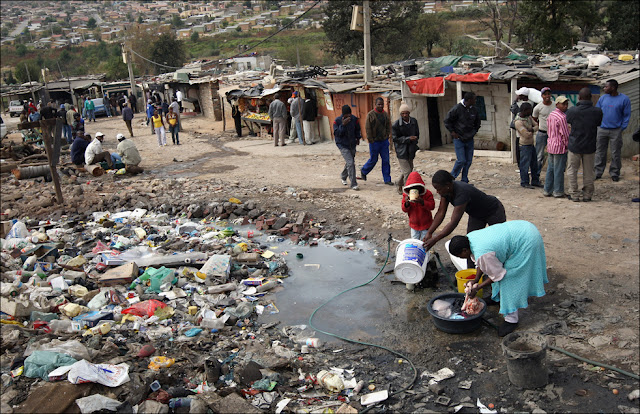
Image: Baastrop If you follow me on Twitter, you will (probably) notice that every week – and sometimes, almost every day – I talk about people who litter the environment with either their urine, feces or other waste products generated from their daily activities. From my tone, you can always tell that I am constantly angry at the unsightly result of our improper waste disposal and management. I wasn’t always this concerned about the environment. In fact, I used to be a huge part of the problem; okay…maybe ‘huge’ is stressing it too far. What I can admit is that I used to toss trash into the streets, gutters and running water and even burn plastic and other waste materials. Not only was I contributing to the dirt in the streets, I was also polluting the air. It is no surprise that at that time, my bedroom used to look like a tornado was constantly running through it. You wouldn’t call me a ‘clean girl’ for anything. My mother would fuss, and discipline, and it never seemed to work. As I got older, I got better…but not by much. Then in 2006, something happened to change my entire outlook on waste disposal. I was fresh out of secondary school and looking forward to a life as an undergraduate. I applied to Ahmadu Bello University for my first and second choice and when it was time for the Post Unified Tertiary Matriculation Examination, or what we simply called Post UME, I was excited to go for the test, and prove why I should get into the school. After a really stressful day of getting lost, struggling to find myself in a sea of people, writing the exam and wondering how I was going to get back home, I decided to have a snack; I had not eaten all day. I bought a sausage roll – Gala – and a drink and sat down at the Social Center to eat. When I was done, I picked up my empty bottle and sausage wrap and crossed the road towards Amina Hostel. As soon as I crossed, I looked around and dropped my empty bottle and wrap on the ground. Just as I did that, my eye connected with a guy who was looking directly at me. I stopped. You know how they say you can shoot darts with your eyes? Well, this guy was shooting grenades! Without one word uttered, I could feel his disapproval, disappointment and anger at my littering. It was in that moment that I really took in my surroundings. There were waste bin every 100 metres and the school environment was clean and the lawn perfected mowed. In fact, there was one waste bin right in front of me. But I hadn’t seen it. I want to blame the stress I had been under but in all honesty, I may not have used it regardless. Remember that I have established that I was the type of person to toss things out into the street, right? Well, my bottle of fizzy drink – and its accompanying sausage wrap – was the aberration to what was a well maintained, really clean environment. It felt like I had insulted the ground – and faculty – of the school. I was awash with embarrassment. Why did I have to openly disregard this beauty that was so carefully put together? Why did I have to show myself like this?! I imagined what the guy must have been thinking about me. I need to put out a caveat though; I wasn’t attracted to the guy. I didn’t want to be liked by the guy. It wasn’t like I wanted to impress him. But the look which he shot me was rife with silent disapproval and judgement. I felt that he had seen into my soul and concluded that I was destructive to the earth. I imagined him thinking me ‘local’, ‘unsophisticated’ and maybe even a ‘village girl’. I was ashamed of myself for not being a better a person. And because of the insecurities I had already been feeling in the new…different environment, I wished I could go back in time and undo my act of sacrilege to the hallowed grounds of the university. To salvage the situation, I acted like I had dropped the trash on purpose. I opened my bag, pretending to look for something and then, bent down to pick them up and toss them into the trash can. With that, I walked away with my shoulders squared, head held high and lips in a defiant pout. But…not before I stole a glance at the guy and saw the beginnings of a smile on his face. That day, I made the choice to stop indiscriminately disposing waste. If I cannot dispose my waste in a proper way, I put it in my bag until I can. The ripple effects of that stink look stayed a long time with me and made me want to be a better person; first to myself and then to my community. I started to clean my house more, keep the ‘tornado’ at bay and generally, act better. As expected, the more concerned I was about my environment, the less tolerant I was of people who littered and worse, peed and pooped in public spaces. Having mentioned that, I have a confession to make. Sometime in 2013, a friend and I went out on a date. I remember drinking from a packet juice and taking some water with the snacks I had. When we returned to his house and I was about to set out for mine, he asked if we could extend the night by taking a stroll. I agreed. Before we left however, I asked for some water and I downed the 60cl sachet that he brought. I felt like peeing, but the pressure wasn’t much. So, I ignored the call and we went out. We took a stroll through the neighborhood and talked and

